The Old Masters of Underwater Painting
Underwater painting is not just a technique.
It is a shift in perception — from observing the ocean to existing within it.
The shifting light, the movement of water, and the unpredictability of the environment create a completely new artistic language.
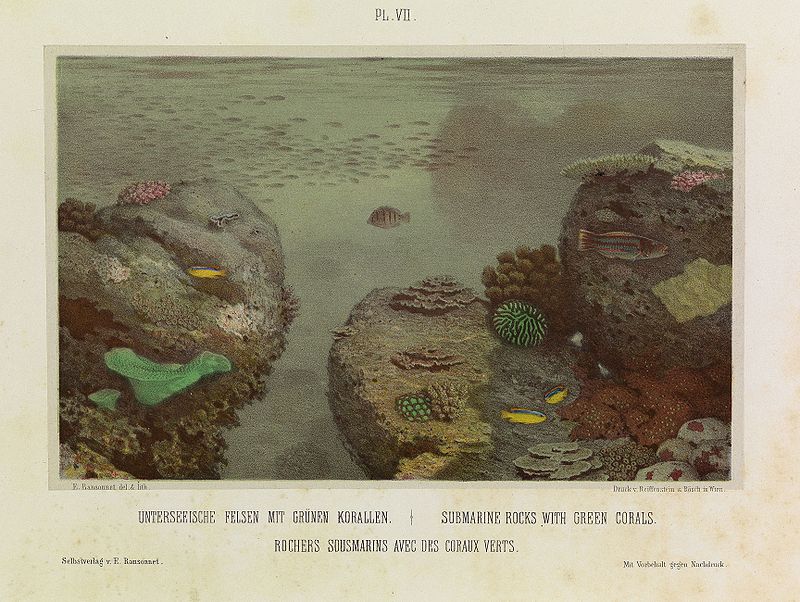
To understand underwater painting, one must begin not with art, but with a limitation—the simple fact that for most of human history, the sea could not be seen from within. The ocean existed as surface, reflection, and imagination. Its depths were inferred, described, or symbolically represented, but never directly experienced by the artist’s eye.
Before the nineteenth century, marine imagery was constructed from fragments: specimens brought ashore, sailors’ accounts, and the inherited visual language of landscape painting. The underwater world, as such, did not yet exist as a visual reality in art. It required not only artistic intention, but technological invention.
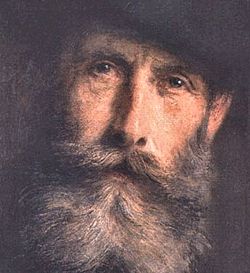
It is here that the figure of Eugen von Ransonnet-Villez emerges—less as a painter in the traditional sense, and more as a mediator between worlds. In the 1860s, he devised a personal diving apparatus that allowed him to descend beneath the surface and remain there long enough to draw. These early immersions, conducted in places such as Ceylon, mark a decisive moment: for the first time, an artist positioned himself inside the environment he wished to depict.What Ransonnet produced were not paintings in the later sense, but something perhaps more radical—visual evidence. His drawings reveal an attentiveness to structure and light that could not have been invented from memory: the branching complexity of coral, the fragmentation of light as it passes through water, the subtle disorientation of space. These works were later translated into lithographs, bridging scientific documentation and artistic representation. They do not yet claim the expressive freedom of painting; instead, they establish a foundation—an insistence that the underwater world must be observed directly, not imagined.
Several decades later, this principle of immersion would be extended and transformed by Zarh Pritchard. Where Ransonnet had drawn, Pritchard painted. And this difference is not merely technical—it signals a shift in intention. To paint underwater is to commit to duration, to material resistance, and to a more complete surrender to the environment.Working in the early twentieth century with heavy diving suits, Pritchard descended with canvases, pigments, and improvised equipment. His practice required not only artistic skill but physical endurance and ingenuity. The easel had to be weighted; the canvas prepared to withstand immersion; the act of painting adapted to an environment in constant motion. Unlike Ransonnet, who returned to the surface to complete his works, Pritchard sought to finish them below. The painting was not a translation of experience—it was the experience itself.
In his writings, Pritchard speaks of color in a way that feels almost corrective. He challenges the assumption that the underwater world is muted or monochromatic, describing instead a vivid and shifting chromatic field. Today we understand the physics behind this—the absorption of wavelengths, the filtering of reds and yellows—but for Pritchard, it was a perceptual discovery. His paintings attempt to hold onto this unstable reality, where color is not fixed but continuously altered by depth, light, and movement.
Between these two figures—Ransonnet and Pritchard—one can trace the emergence of a new artistic condition. The artist is no longer positioned outside the subject. There is no stable ground, no controlled lighting, no separation between observer and environment. Instead, the act of painting becomes contingent, responsive, and physically embedded within the world it represents.The technical challenges faced by these early practitioners cannot be overstated. Underwater, the body is never still. Even in calm conditions, there is a constant drift—a subtle but persistent movement that disrupts precision. Time is limited by air supply and physical strain. Vision itself is altered: distances compress, edges soften, and colors shift according to depth. Materials behave unpredictably; paint disperses, surfaces resist, tools become cumbersome.
And yet, it is precisely these limitations that define the aesthetic of underwater painting. The works are not attempts to overcome the environment, but to negotiate with it. They carry within them the trace of their conditions—the hesitation of the hand, the urgency of execution, the instability of perception.
By the mid-twentieth century, the development of scuba technology would fundamentally alter this dynamic. With the arrival of more flexible and extended underwater mobility, artists could remain submerged longer and move more freely. In this context, the work of André Laban becomes especially significant.Associated with the expeditions of Jacques-Yves Cousteau, Laban represents a shift toward a more fluid and expressive approach. The constraints of earlier methods were not eliminated, but transformed. Where Pritchard’s work bears the weight of effort and resistance, Laban’s paintings often convey immediacy—a sense of painting as a gesture made within time, rather than against it.
The evolution from Ransonnet to Laban can be understood not simply as a progression of technique, but as a deepening of immersion. What begins as observation becomes participation. What begins as documentation becomes expression.
And yet, despite these changes, something essential remains constant. Underwater painting continues to resist complete control. It demands adaptation, attentiveness, and a willingness to relinquish certainty. The artist does not impose order on the environment; instead, they enter into a dialogue with it.
In this sense, the early figures of underwater painting—the so-called “old masters”—did more than establish a new genre. They redefined the conditions under which art can be made. They extended the act of painting into a space where vision is unstable, time is limited, and the environment is active rather than passive.
Their legacy is not only historical, but methodological. To paint underwater is to accept that the world cannot be fully fixed on canvas—that it must, in some way, remain in motion.
And perhaps this is the most profound contribution of these early artists:
they did not simply bring painting beneath the surface.
They allowed the surface itself to dissolve.